


- This topic has 3 replies, 1 voice, and was last updated 5 years ago by
.
-
Topic
-
effect of increased voltage on motor
What will happen when an 3 phase Sq.cage induction motor operates with increases voltage and frequency than rated ?
Losses of the motor increases or decreases when operates as said above?

Viewing 3 replies - 1 through 3 (of 3 total)
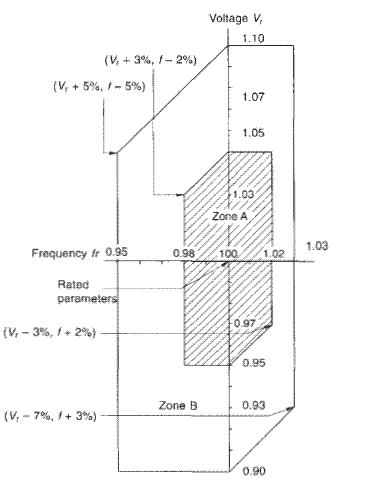
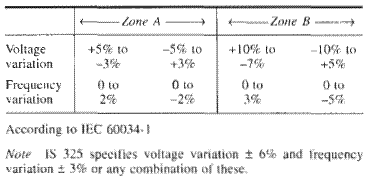 Where, however, a higher variation in voltage and frequency is envisaged, motors suitable to fall within zone B in below Figure can also be manufactured.
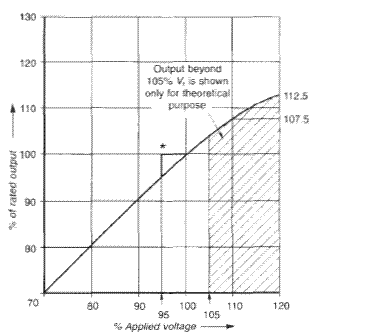
  An increased voltage should improve the performance of the machine in the same way by reducing slip and the associated slip losses and also stator losses as a result of lower stator currents, but this would hold good only up to a certain increase in voltage, say up to 5%. Beyond this, not only will the no-load losses, as discussed above, assume a much higher proportion than the corresponding reduction in the stator current and the associated losses, the winding insulation will also be subject to higher dielectric stresses and may deteriorate, influencing its operating life, while at overvoltages of about 10% and higher the insulation may even fail. Moreover the stator current may start to rise much more than the corresponding increase in the output to account for higher no-load losses and a poorer power factor. Below figure illustrates the approximate effect of voltage variation on the motor output. Higher voltages beyond 5% may thus be more harmful, even if the insulation level is suitable for such voltages.
  The circle diagram of Figure explains this by shifting the semicircle to the right, because of higher Inl and
 Viewing 3 replies - 1 through 3 (of 3 total)
- You must be logged in to reply to this topic.