


- This topic has 1 reply, 1 voice, and was last updated 5 years ago by
.
-
Topic
-
In a Transformer Bushing, there is a mention about the tan δ, that represents the loss factor of the bushing. What does the two values of tan δ indicate? …
In a Transformer Bushing, there is a mention about the tan δ, that represents the loss factor of the bushing. What does the two values of tan δ indicate? What are the capacitance involved for the performed tests of tan delta?

Viewing 1 replies (of 1 total)
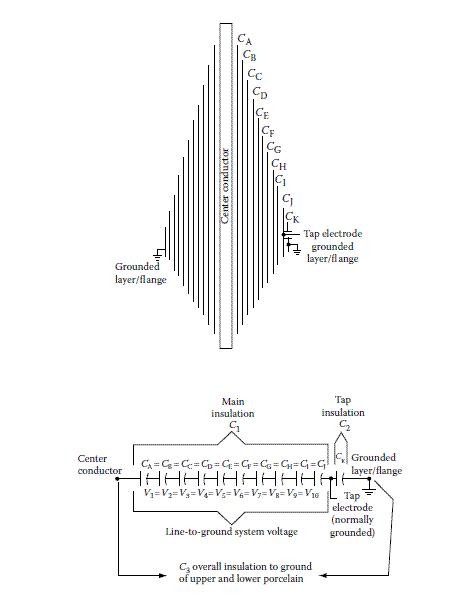 Therefore the total capacitance (C) is equal to 0.1 pf. For example, if one capacitance layer breaks down then the capacitance of the bushing would be one-ninth or 0.11 pf; or an increase in bushing capacitance of 0.01 pf, or 10% increase. Figure above also shows the various insulations associated with the condenser-type bushing. The main insulation C1 is the insulation from conductor to the tap electrode or shield layer; the tap insulation C2 is between tap electrode and ground or flange; and C3 is the overall insulation to ground of the upper and lower porcelain. PF tests on bushing are usually performed by energizing the bushing conductor and measuring the test current and loss for the insulation system between the conductor and grounded flange. Many modern bushings have capacitance taps or PF test taps. Test on bushings with taps can separately determine the core insulation (C1) from the tap insulation (C2). The various insulation systems of the bushing with taps are shown in Figure below.
Viewing 1 replies (of 1 total)
- You must be logged in to reply to this topic.