


- This topic has 2 replies, 1 voice, and was last updated 4 years, 11 months ago by
.
-
Topic
-
نسبت X به R چيست؟ در بعضي از نرم افزار هاي محاسبات شبكه با به گزينه ايي بر ميخوريم كه نسبت X به R را مي خواهد مثلا در نرم افزار ETAP7 كه سوال من اين است اين نسبت چيست و منظور از اين دو پارامتر كدام است؟
نسبت X به R چيست؟ در بعضي از نرم افزار هاي محاسبات شبكه با به گزينه ايي بر ميخوريم كه نسبت X به R را مي خواهد مثلا در نرم افزار ETAP7 كه سوال من اين است اين نسبت چيست و منظور از اين دو پارامتر كدام است؟

Viewing 2 replies - 1 through 2 (of 2 total)
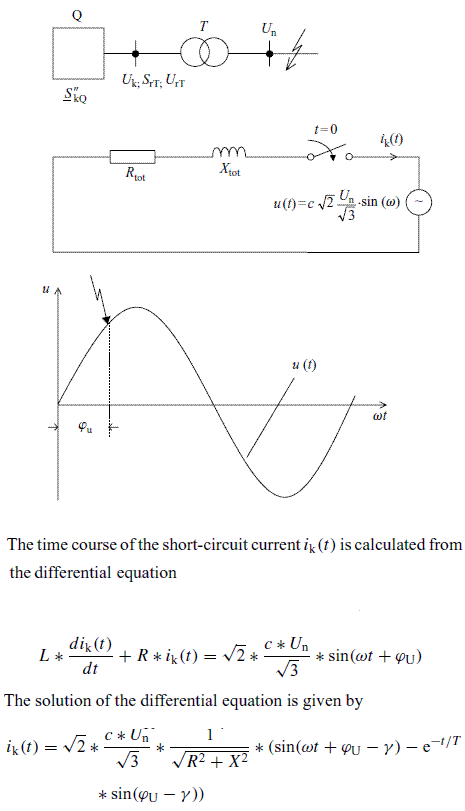 where Un is the nominal system voltage, ϕU is the angle of voltage related to zero crossing as per Figure, c is the voltage factor according to Table below, T is the time constant: T = L/R, X is the reactance of the short-circuit impedance: X = ?L, R is the resistance of the short-circuit impedance, ? is the angular velocity and ? the angle of the short-circuit impedance: ? = arctan(X/R).
 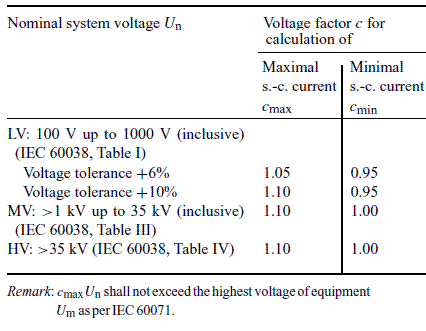 The initial short-circuit current I”k is equal to the first part (periodic term) of above Equation, the second term is the aperiodic and decaying d.c.-component of the current. If the time course of the short-circuit current as per Equation is related to the peak value of the initial short-circuit current
 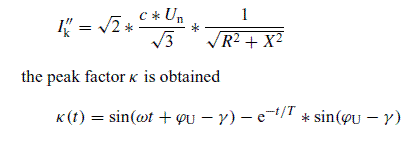 The maximum of the peak factor ? determines the maximum of the short-circuit current (peak short-circuit current ip) to be calculated by partial differentiation of Equation with respect to ϕU and t . The maximum of the peak factor always occurs for short-circuits at ϕU = 0 and t ? 10 ms (50 Hz), respectively t ? 8.33 ms (60 Hz), whatever the ratio R/X might be
 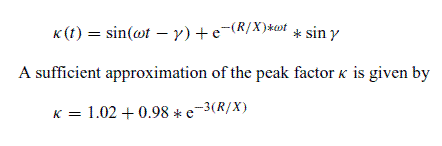 Special attention for the calculation of peak short-circuit current must be given in the case of short-circuits in meshed systems or in systems having parallel lines with R/X-ratios different from each other. A detailed analysis of these conditions is given in IEC 60909-1.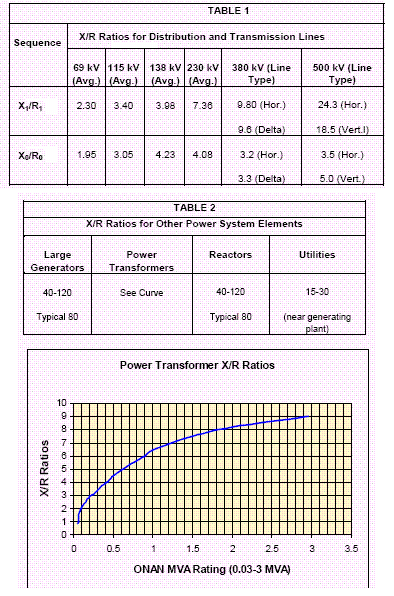
Viewing 2 replies - 1 through 2 (of 2 total)
- You must be logged in to reply to this topic.